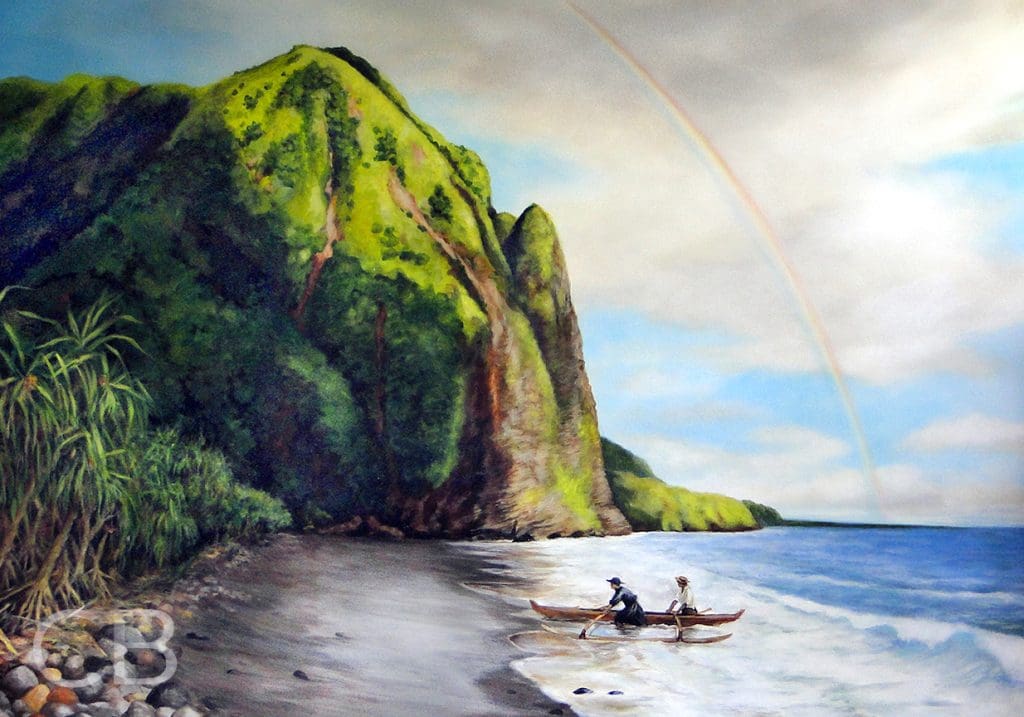
Saint Damien is best know for his work among leprosy patients (now Hansen’s disease) in Kalawao on the Kalaupapa peninsula in Hawaii. Long before, sainthood Father Damien paddled a two man canoe with a friend from Kalawao, where he lived, to Halawa Valley to visit the other churches he established on Moloka’i. This painting is one in a series inspired by the life of Saint Damien.
Exploring the deep ravines and wild rivers of Molokai’s steep, remote valleys requires time and patience. When I first asked about hiring a boat to get to Wailau Valley to camp I was told that ‘back side Molokai’ was a lawless place and people didn’t always come back. Various people said that wild pigs would eat me while I slept, supernatural night marchers guarded the valleys, dope growers set traps and man-eating sharks guarded the bays. Pristine places stay that way if few people find them.
On the other hand locals talked about fun family camping trips to Wailai and Pelekunu. Clearly they lived to tell about it, but when I asked how to get there, they invariably brought up killer pigs.
Eventually I met a woman who owned land in Wailau Valley and she gave me permission to visit. A friend and I hired a fishing boat to drop us off and pick us up a week later. We swam ashore, over a gray sand bottom, no sharks in sight, with our camping gear in a cooler and buckets.
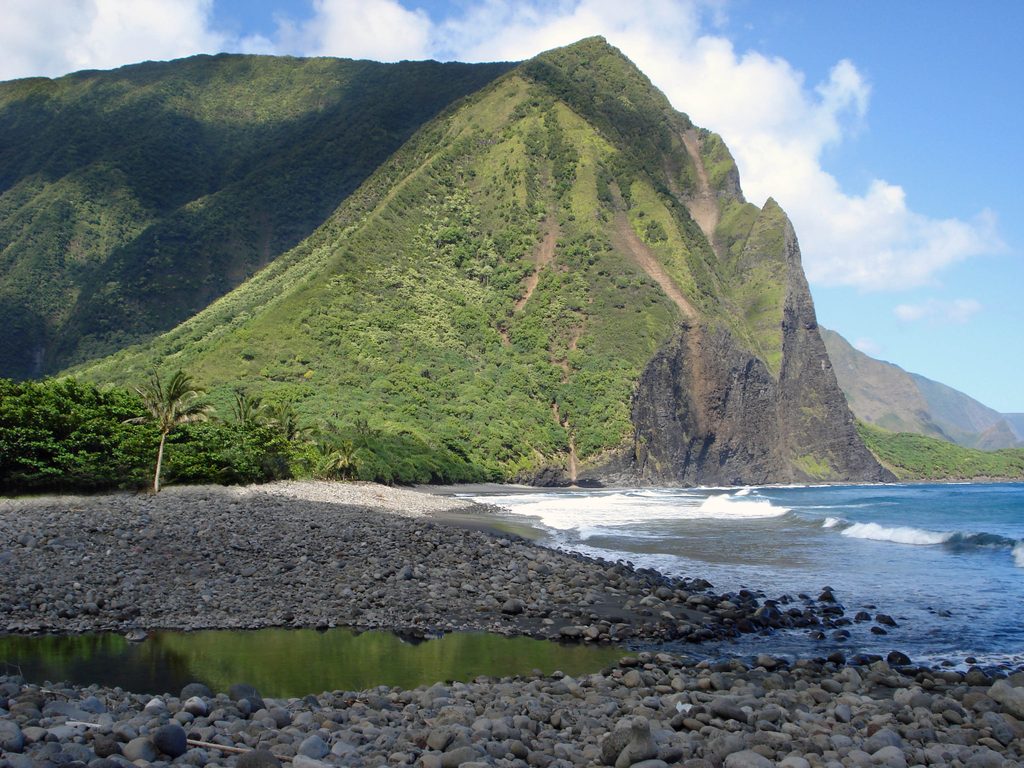
Roughly one and a half million years ago a massive landslide broke the northern third of the island off, dumping it on the sea floor and creating the island’s famous 3,000-foot-high sea cliffs.
Intense rainfall eventually sculpted deep, fertile valleys which were inhabited by seafaring Polynesians over a thousand years ago. Estimates of the peek population in the valley range from ten thousand or more. Wailau means many waters, although there is no accurate count of the hundreds of waterfalls that line the cliffs when it rains as it is always changing.
Audrey Sutherland swam the entire back side many times and never ran into any sharks, but I can’t understand how her imagination allowed her to swim for days in the open ocean from valley to valley. There are people we are not supposed to compare ourselves to. Her 1978 memoir, documents her late 1950’s adventures swimming and paddling Molokai, republished as “Paddling Your Own Canoe” in 2019.
It used to be possible to hike over the mountain and down into the back of Wailau Valley. The ancient trail is printed on maps, but from what I could learn it has not been traversed in many years. Supposedly there are ragged bits of rope left for swinging across the sections of trail that have fallen away. No thanks, although it could be another story akin to a killer pigs.
On the boat ride a helicopter high over the vertigo inducing sea cliffs looked like a gnat. To the people looking down we probably looked like a Styrofoam cup.
Land in Wailau Valley is privately owned, divided into parcels, and camping is allowed by the discretion of the owners. Several families who own plots set up camps on the beach for the summer.
I had been told the river water was fine to drink, but it didn’t look so good after we began exploring. There was a lot of algae growth, usually meaning slow moving water and more chances for bacteria. One dead thing upstream can ruin a good camping trip. I boiled water from the stream, until we met up with people who showed us artesian springs where pure water flowed out of the mountainside.
We hauled our gear to the beach, below the cliffs in the painting, surrounded by coconut and hala trees. The ocean crashed at our front door and cliffs rose straight out of the beach on either side. On closer inspection the ground looked much too organized. I swept fallen fronds away with my foot and found ancient steps leading to a large platform of stone with embedded with leaning stones. Wailau Valley remains undisturbed, aside from changes wrought by nature. Short rock walls, lo’i, snake through the valley forming terraces for growing taro, evidence of many hands working long ago. The last Hawaiian residents to survive cholera and other devastating diseases brought by European explorers vacated the valley over one hundred years ago.
At dusk men from a camp near the river walked into the light of our camp fire wearing camouflage clothing, rifles slung over their shoulders. They came to tell us they were going hunting for deer, pigs and goats so we wouldn’t accidentally get in the way. They invited us to stop for breakfast in the morning at their camp, which was not my first thought when I saw men with guns. It was a polite invitation, but one not meant to be used. We dropped off oranges and let them know we were going hiking. An exchange of food is standard peacekeeping in Polynesia, whether offered or handed over without fanfare.
Halfway into the valley we stumbled onto a swimming hole, deep and wide enough to dive in and swim laps. A gigantic, ancient koa tree clung to the steep side of the pool spreading shade over the swimming area. It must have been the playground of kings and queens. There was a feeling of privilege in a place so perfectly formed. We climbed the cliff, scrambling up the roots of the tree. Overlooking the swimming hole rocks had been laid in regular patterns. In that ancient, unspoiled place I had the feeling people had lived well, but with all ancient ruins comes an undercurrent of interminable sadness for all that has been forever lost.
By the time the boat came to fetch us, our minds had slowed to the rhythm of the sun traversing the sky. We met a few people who lived way the hell off the grid deep in the valley and visited their well hidden working taro farm, as if going back in time a thousand years. On our last morning a rainbow graced the sunrise as we packed our buckets, lighter now for having eaten all the food. Wailau Valley is difficult to reach, which has preserved it’s wildness and ancient ruins. I left with a calm mind and a full heart. Time in the valley offers an intangible elixir that only nature at its most fertile and pristine imparts.
Please write to clbnyart@gmail.com for print sizes and prices or information about commissions,
I personally answer all inquiries and look forward to hearing from you.